


is a site-specific installation by Nazanin Noori at the Klosterruine Berlin. It connects the historical space of the former religious building with questions of religious affiliation, power structures, public perception, and diverse conceptions of the divine. As a relic of a sacred site, the Klosterruine points to the political and social systems that have historically emerged from religious organisation. For centuries, the Berlin Franciscan monastery functioned as a space in which spiritual practices—both aesthetic and performative—were closely intertwined with urban order and political authority. At the same time, the ruin stands as a marker of repeated destruction and transformation.
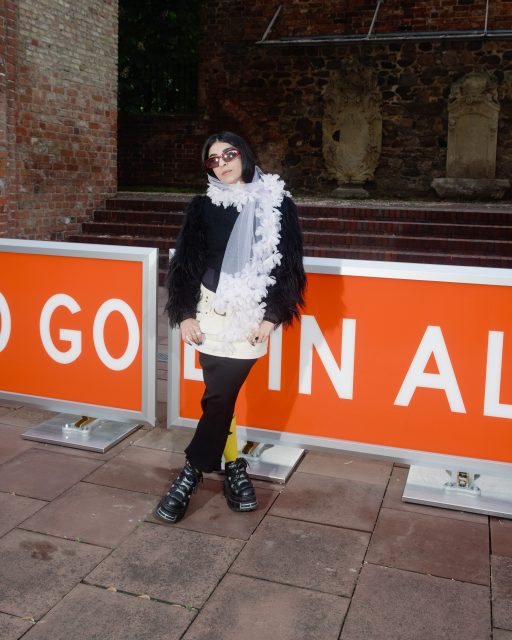
The installation consists of four illuminated signposts arranged in front of the preserved grave monuments, forming a twelve-metre-long linear light sculpture. Each module is based on a runway sign used in aviation: a rectangular aluminium structure with a signal-orange front surface, evenly lit from within. These signs typically organise airport grounds, marking transitions between functional zones, indicating directions, and regulating movement along runways.
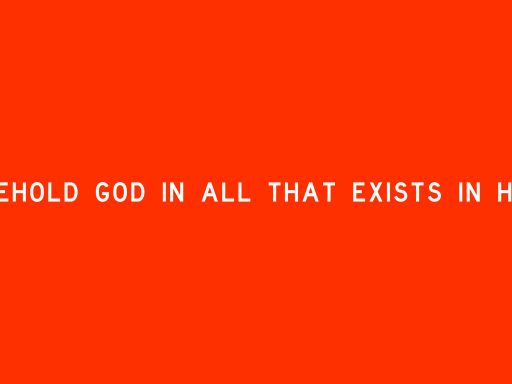
Here, however, the runway signs are removed from their functional context. Placed closely side by side, the four modules form a continuous horizontal line of light displaying the phrase BEHOLD GOD IN ALL THAT EXISTS IN HIS NAME in large white block letters. This serial arrangement creates a rhythm of light and text that cuts through the architectural space of the ruin as a defining gesture. The juxtaposition of a sacred site with a technical lighting structure reveals a historical framework in which religion has shaped societal ideas of order, authority, and collective identity.
authority, and community. Religious architecture has long played a key role in shaping collective identities, extending far beyond the boundaries of the liturgical space.
The installation also draws on pantheistic modes of thought, as suggested in the phrase “BEHOLD GOD IN ALL THAT EXISTS.” Within pantheism, the divine is not understood as a distant, separate entity, but as an immanent presence. The world itself becomes an expression of the divine, with each of its elements carrying this presence within it. This perspective appears across a range of philosophical and religious traditions, including Stoicism, Neoplatonism, Spinozism, and various mystical currents.
As a framework, pantheism challenges the logic of religious exclusivity. If the divine is equally present in all things, the idea of a single “true” God—claimed or defended by one specific group—loses its foundation. In its place emerges a view centred on interconnectedness, equality, and mutual entanglement.
At the same time, the title of the installation remains deliberately ambiguous. The addition “IN HIS NAME” points to historical and political mechanisms through which religious language has been used to stabilise collective identities—often legitimising exclusion, hierarchy, and violence. In this context, the work also resonates with feminist theological perspectives, which since the 1970s have critically examined the patriarchal structures embedded in religious language and shown how concepts of a male-coded God are closely tied to broader systems of power.
In aviation, illuminated runway signs function as guides, marking transitions between different operational zones. Within the installation, however, they become static objects. The light suggests direction without initiating movement—apart from the movement of reading and reflection.
Positioning an artificial, electrically generated continuous light within this space—one that is not sacred—also underscores the fragility of the site itself: suspended between earlier notions of religious permanence and a form of technical permanence that remains inherently unstable.
Ruine der Franziskaner Klosterkirche
Klosterstraße 73a,
10179 Berlin